Happy 162nd birthday to Mary! Born Mary Kenney on January 8, 1864 in Hannibal, Missouri, this daughter of Irish immigrants went on to organize factory workers, demand women’s rights in the workplace and the voting booth, co-found the Women’s Trade Union League, and hold industries accountable as a factory inspector.
Mary is one of my personal heroes for her courage, humor, strength, and perseverance. She made friends with the movers and shakers in the Progressive and Peace movements of her day and she never stopped fighting to protect worker rights, women’s rights, human rights.
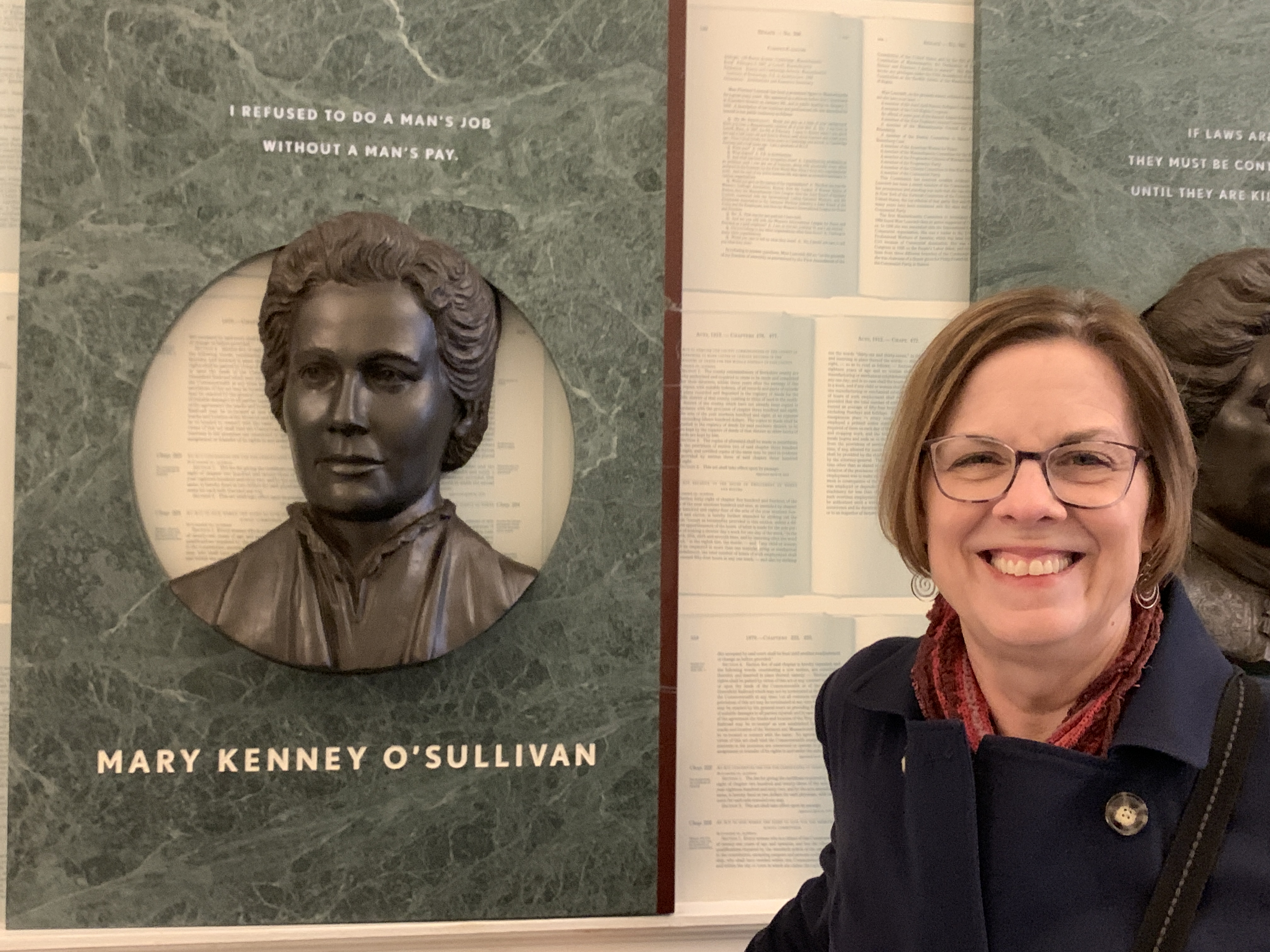
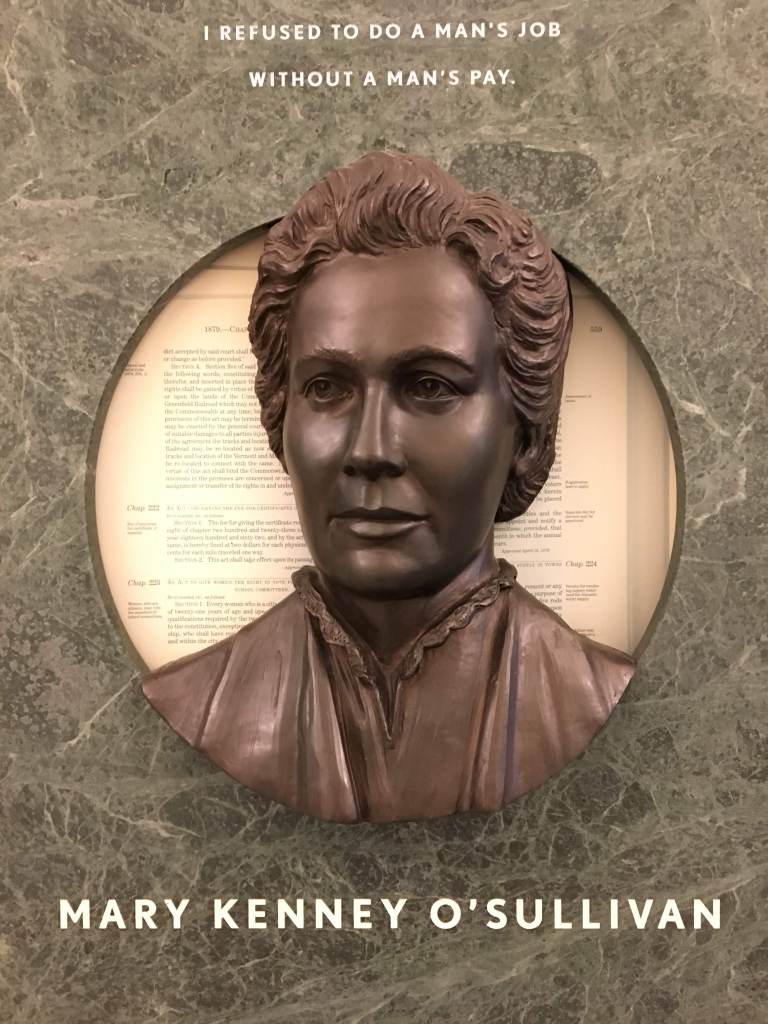
I’m posing with a bronze bust of Mary that is part of the multimedia installation HEAR US: Massachusetts Women’s Leadership Memorial at the Massachusetts State House. The words above her portrait are a direct quote from her unpublished autobiography.
Mary Kenney’s rise to fame, or perhaps notoriety, within women reformers’ circles, was fairly well documented due to her connection with the Hull House in Chicago, her move to Boston to work with the Women’s Educational and Industrial Union, and her marriage to labor leader and activist Jack O’Sullivan. But after Jack’s death, there is not much to go on to tell us how she initially survived as a widow with three small children. Falling back on her unpublished autobiography, I found clues about her life as a once-again wage earner and the limited opportunities open to her in Boston as a working-class single woman and sole support of her family. She had support from Jack’s friends to give her a job, and from a particular young woman of the upper class who wanted to learn how to support working people. Using these facts, I imagined what Mary, now a widow over the age of 40, might have felt as she navigated her rising fame in the world of union organizing simultaneously with the gritty reality of bread-winning in the rough-and-tumble environment of early-1900s Boston. Details below, including a sheepskin sleeping bag, a tenement house, help from a young local heiress, and a pistol under a pillow are all from Mary’s own account of her circumstances around 1906. Her thoughts about the situation are from my imagination (all rights reserved, etc., blah, blah, blah).
Up on the roof
Shifting around in her sleeping bag until she had a good view, Mary looked up into the open sky. It was a moonless night, with only a stray cloud or two, which sharpened the brilliance of the constellations against the deep blue-black heavens. She felt between heaven and earth on nights like these, sleepless but peaceful; grieving, yet grateful; angry but unwilling to give in to bitterness. She was partially sheltered by the roof extension her dear little friend Rosalind had so kindly helped build. She could hear the crackle of the tar paper beneath her makeshift bed but was high up enough to escape the worst of the tenement district’s smells. She reached up and patted her pillow, comforting herself with the knowledge that the gun was just in reach.
Boston tenement, undated, c. 1900; Boston City Archives
What a life! She smiled up into the sky as tears welled in her eyes. What would Mother say if she could see her now? To be sure, she’d have none of this nonsense of a daughter, a mother of children for goodness’ sake, up sleeping on a tenement roof in the worst part of this dirty old city with a pistol under her pillow! Poor dear Mother. It seemed only yesterday that she had passed. Father had been gone so long, since Mary was just a girl, but she thought he might be proud, and would tell her she had “the courage of Brian Boru!” She felt lucky to have had a papa who kept her near and let her try things – even crazy things like riding a horse bareback. Her childhood friends had been astonished by her stunts, declaring “you’ll die with your shoes on, Mary Kenney, you will!” She laughed out loud remembering her antics, and the night sky seemed a little closer and even more lustrous. She grinned as she tapped her toes together, snug in shoes inside the sheepskin sleeping bag.
She’d been sleeping up on the roof for just a few weeks and was willing to continue as long as the tenants under her charge were vulnerable to theft and assault. After all, nobody else was willing to do the necessary – and hadn’t she always been the one to step in when nobody else could or would? When Mr. Cabot made her the agent of the real estate company’s Boston properties, a day after Jack’s funeral, it was her return to wage earning, now as the sole support of herself and her three little children. The company’s buildings were in desperate need of cleaning up – the buildings themselves, as well as the inhabitants. She gritted her teeth thinking of what it took to smoke out the no-gooders in that first building in Roxbury. At least Cabot had made sure the many renovations she insisted upon were made. The previous agent had gone ahead and let rooms in that building, which had been designed for offices, not for living apartments. She sighed and shook her head, remembering her astonishment not only at the situation, but also at the complacent mindset that simply accepted that this was how poor tenants were going to have to live. She now had her office on the first floor of this building in the South End, but due to repeated break-ins, Mary insisted on a safer perch to guard her charges.
She closed her eyes and said a short prayer for Jack, as she had every night for more than four years, trying to keep her focus on the repose of his soul. Mary was rarely successful at this, and she let a few of the tears that had been welling slide from beneath her closed lids. She hated when this feeling of self-pity threatened to intrude on her love for this man and her warm memories of their all-too-short life together. Just eight years of marriage, but what a marriage it was. Again and again, she recalled their first meeting, her first days in Boston, the almost electric thrill of being swept along in his wake, his delight in showing her his city’s byways, their mutual sense of justice and their love of doing good for others. They were building a beautiful family and a beautiful life – and a senseless accident took it all away.
No, not all away, she reminded herself. Our children are here and must thrive and remember their daddy and everything he – we – stood for and stand for. She wiped away a tear and smiled at the stars again. All of those friends who stood by us and still stand by me – Jack is gone, but none of those friends will ever forget him, or me, she thought. She had never learned much about the stars – a fourth grade education in Hannibal, Missouri, gave you the three Rs, but not much else. But recently she’d been learning about the constellations and how people all over the world believed in how the stars align and connect, and how shapes appear and reappear as the great world spins.
She had so very many stars in her firmament, she thought. The brilliant Miss Addams must be my North Star, she mused, since she is the biggest and brightest of all. Miss Addams connected me with Miss Kimball and her sister Mrs. Kehew here in Boston, and when the right season in my life came about, I was drawn into the powerful constellation that included Miss Dudley and Miss Scudder at the Denison House. These women changed my life, she reflected, and were changing the lives of so many people suffering poverty and injustice here and around the world. Even that young thing, Rosalind Huidekoper, an heiress barely out of her teens, has come into my orbit, following me around to learn about cooperative living and using her fortune to help supply this tenement with what I need.
She felt the tar paper crackle as she shifted again and heard the muffled steps of the patrolman on the beat, four stories below. She felt drawn back to earth, the solid, salty, faulty reality that she witnessed daily. She knew that she had seen and experienced so much that most of her friends never would – the death of a child, the love of a husband, the insult of being told that the work of your hands was not worth that of the same work by a man’s labor – and she resolved again not to grow cynical. She was an armed guard on a tenement roof by night, and an officer of the Women’s Trade Union League by day. She had to keep fighting. She had to. It was up to her. Someone had to do it, and she must be that someone. She drifted off to sleep at last.
Chicago World’s Fair 1893 – image courtesy Boston Public Library
Reading through the digitized version of Mary Kenney O’Sullivan’s unpublished autobiography provides more than a glimpse of her personality. Her sense of humor, her passion for justice, and her fearlessness are apparent. Several times while reading her anecdotes, I thought, “this woman was afraid of NOBODY.” While she admitted to feeling intimidated by upper class women before she met the great Jane Addams, she seemed to have had a powerful sense of self-worth and self-respect that no ill treatment or condescension could diminish. She even described a childhood incident, where she refused to return to the private Catholic school where the nuns held her back a grade, as “my first strike.” But it’s her encounter with the legendary Susan B. Anthony in 1893 that really surprised and impressed me.
On pages 94 and 95 of her autobiography, Mary talks about the wonders of the Chicago World’s Fair. Fellow fans of The History Chicks podcast will know that “all roads lead to the Chicago World’s Fair of 1893,” since so many of the historical women they speak of have a connection at this event. I was delighted to find Mary’s description of the fair as “a peep into the Book of Knowledge.” She writes,
“A part of every corner of the world was brought to us in Chicago. To a young girl with as limited an international background as I had, it was a miraculous opportunity. Lecturers came from all over the world and lectured on every phase of life.”
She might have been young (29) but she had already been sought out to come to Boston to expand the organization of wage-earning women there; and she’d been a close friend of the famous Jane Addams for about a decade by this point. So when she name-drops Addams and two other leaders of the Woman’s Branch of the World’s Congress Auxiliary, it’s not very shocking. She goes on to express how happy she was to have been given admittance to all the exhibitions and lectures, and how grateful she felt. But her next name-drop felt rather abrupt as she starts the next paragraph: “One night Miss Susan B. Anthony, Mrs. Florence Kelley and I were speaking at the fair from the same platform. ” The first time I read that, I laughed in surprise, my mouth dropped open, and as I read it again I could hear the voice of The History Chicks co-host Beckett Graham in my head, remarking “Like you do.”
Not only does this unworldly 29-year-old factory forewoman share the platform with the 73-year-old éminencegrise of the women’s suffrage movement, she makes sure to show her what’s what. According to Mary,
“Miss Anthony had always been opposed to unions and strikes. Her subject that night was “Suffrage” and mine was “The Value of Labor Organizations”. It was a hot, sultry August evening. The lecture building had a low ceiling. There had been a rain storm in the late afternoon, and the janitor had closed all the windows, which were very high. Mrs. Kelley, Miss Anthony and myself arrived at the hall and found the heat intolerable. The janitor refused to open the windows. I suggested to Mrs. Kelley and Miss Anthony that we see the manager, but he also thought it wasn’t necessary to open the windows for a few hours. I suggested to my two co-workers that we refuse to speak till the windows were opened. They agreed and we had our way. I couldn’t resist the opportunity of reminding Miss Anthony that we had just won a strike.“
I have searched extensively for the speeches that Anthony, Kenney, Kelley would have given on that hot August night, to no avail. I have found confirmation that not only did Susan B. Anthony spend most of 1893 at the event, but also that the National American Woman Suffrage Association held meetings there between August 7 and 12 as part of a Congress on Government. The earlier World’s Congress of Representative Women, held in May, has documented the speech Anthony gave that was written by Elizabeth Cady Stanton. That and Mary Kenney’s speech from May 1893 were captured in a book edited by May Eliza Wright Sewall, The World’s Congress of Representative Women, vol. 2, Chicago: Rand and McNally, 1894. The wonderful Speaking While Female Speech Bank created by Dana Rubin has Mary’s May speech in its entirety here: https://speakingwhilefemale.co/jobs-kenney/.
Just as Mary insisted on the dignity of the other speakers and herself by getting those windows opened in the lecture hall, her speech called on women to learn, and then to act, and not to accept the miserable and demeaning conditions found in so many unorganized factory operations, which she called, “wholesale prostitution, crime, and degradation.” It was clear to me that someone who made no bones about publicly referring to factories as “no better than slave prisons” was not going to be intimidated by the opinions of the famous Miss Anthony, nor anyone else.
Quotes from pages 94-95 of the unpublished autobiography of Mary Kenney O’Sullivan, 1936, part of the Papers of Mary Kenney O’Sullivan, 1892-1943, Schlesinger Library, Cambridge, Mass.
Papers of Mary Kenney O’Sullivan, 1892-1943, at the Schlesinger Library
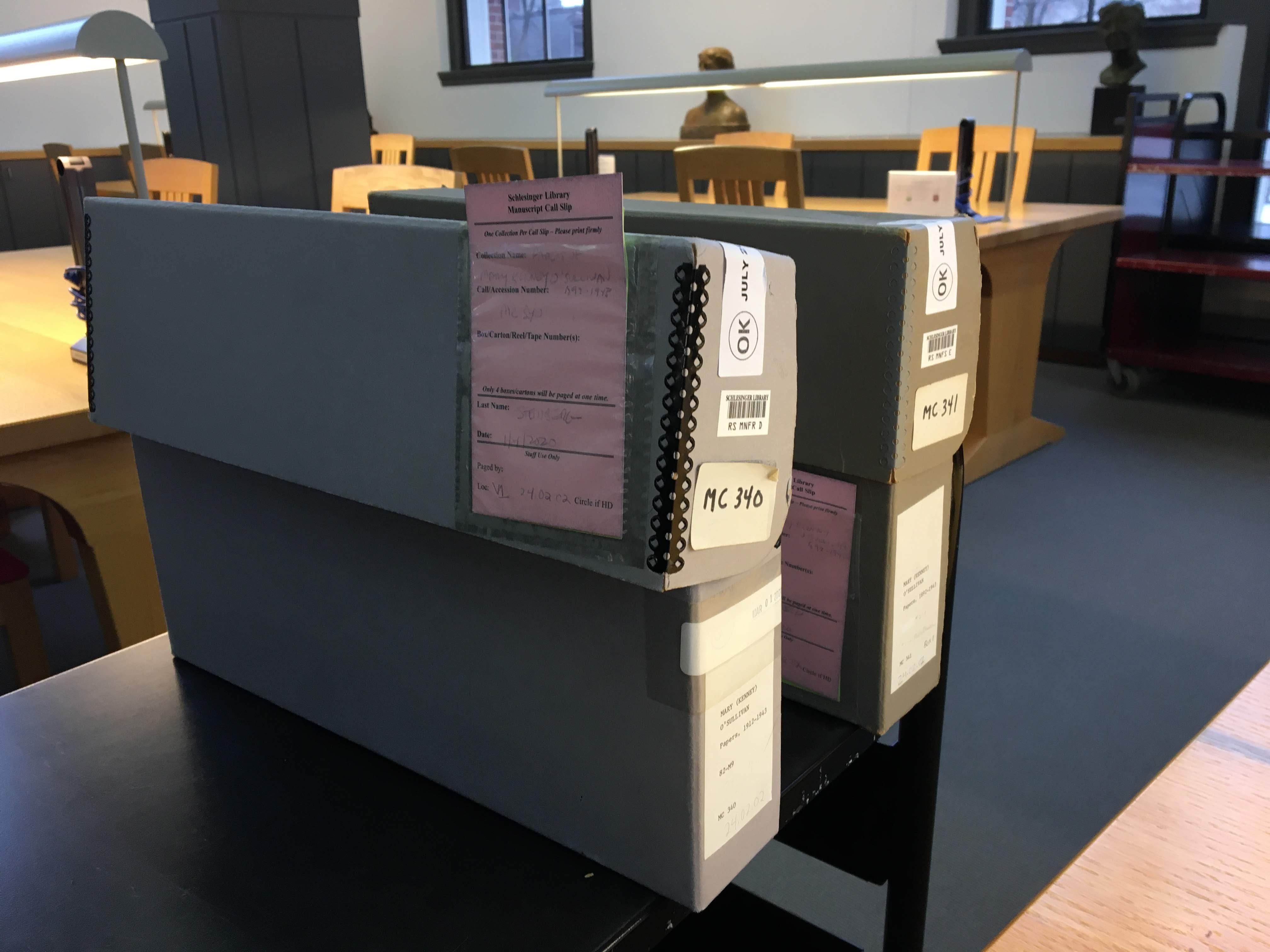
My first foray into non-electronic research about Mary Kenney O’Sullivan brought me to the Schlesinger Library, a unique resource for the history of women in the United States. It is at the Harvard Radcliffe Institute in Cambridge, Massachusetts. It’s a fairly young institute, born in 1999 but rooted in its own women’s history going back more than 100 years. Since Harvard University, founded in 1636, didn’t admit female students, Radcliffe College, founded in 1879, was the sister school. While women were enrolled in Harvard’s medical college and other graduate programs much earlier, Harvard did not become truly co-educational until 1974. I’d love to talk more about the women responsible for the very existence of Radcliffe (Elizabeth Cary Agassiz) and the Schlesinger Library (Maud Wood Park), but perhaps I’ll get to that in another post. What I want to share here is how I used this fantastic resource that is practically in my back yard to learn more about Mary Kenney O’Sullivan.
Even with Harvard right down the road, I felt a bit intimidated to pursue this next step in research, mainly because I have no idea what I’m doing, but also…Harvard…whew! The Schlesinger Library website is absolutely amazing, and during my Christmas break from work, I searched its site and others incessantly for more about my subject. I kept coming back to the information about how to visit and how to access materials, of course during a time the library was closed for the holiday break. By January 2020, I’d gotten organized enough and brave enough to make the visit.
There was hardly anyone else visiting on a weekday before classes had started and the research librarians were helpful and efficient. First, they gave me access to download the scanned document that was Mary’s unpublished autobiography. Then they pulled the two file boxes containing the papers of Mary Kenney O’Sullivan, pointed out the rules for handling the items, and left me to go through them. I couldn’t believe I could “keep” Mary’s autobiography in digital form; and I was incredulous that I was about to handle her papers and effects.
So what was in those boxes? I was allowed to take photos of everything; I’m allowed to quote things; and I’m allowed to share images with proper attribution. Having read Kathleen Banks Nutter’s The Necessity of Organization, I knew a fair amount about Mary’s early life, her connection to Jane Addams and Hull House, her marriage to Jack O’Sullivan, and her work up until 1912 in organizing women in Boston and the surrounding area. Seeing and touching an envelope with Jane Addams’ scrawl addressed to Mary was surreal. Newspaper clippings were mostly in pretty bad shape, but provided an interesting backdrop to Mary’s life in trade unionism, suffrage, and the international peace movement. It was encouraging to know there was this much coverage that I will likely be able to find online. I found her train tickets, writer’s union card, a ragged ribbon on a pin with the suffrage colors, address books, and her official Massachusetts state government business card. I had to laugh at the last one as I was a state employee from 1987-1996 and apparently not even the font style had changed on those business cards in 60 years.
Mary Kenney O’Sullivan’s business card from her employment with the Commonwealth of Massachusetts, from the Papers of Mary Kenney O’Sullivan, 1892-1943, Schlesinger Library
Yes, Mary was a state worker, an inspector with the Department of Labor and Industries in the Division of Industrial Safety. A tattered scrap of newsprint still held a story and photo of her retirement in 1934, days before her 70th birthday. It was the kind of job she might have had in her late 20s with the state of Illinois had she stayed in Chicago working with powerhouse activists like Jane Addams and Florence Kelley. Instead, it was her paid work in her energetic older years.
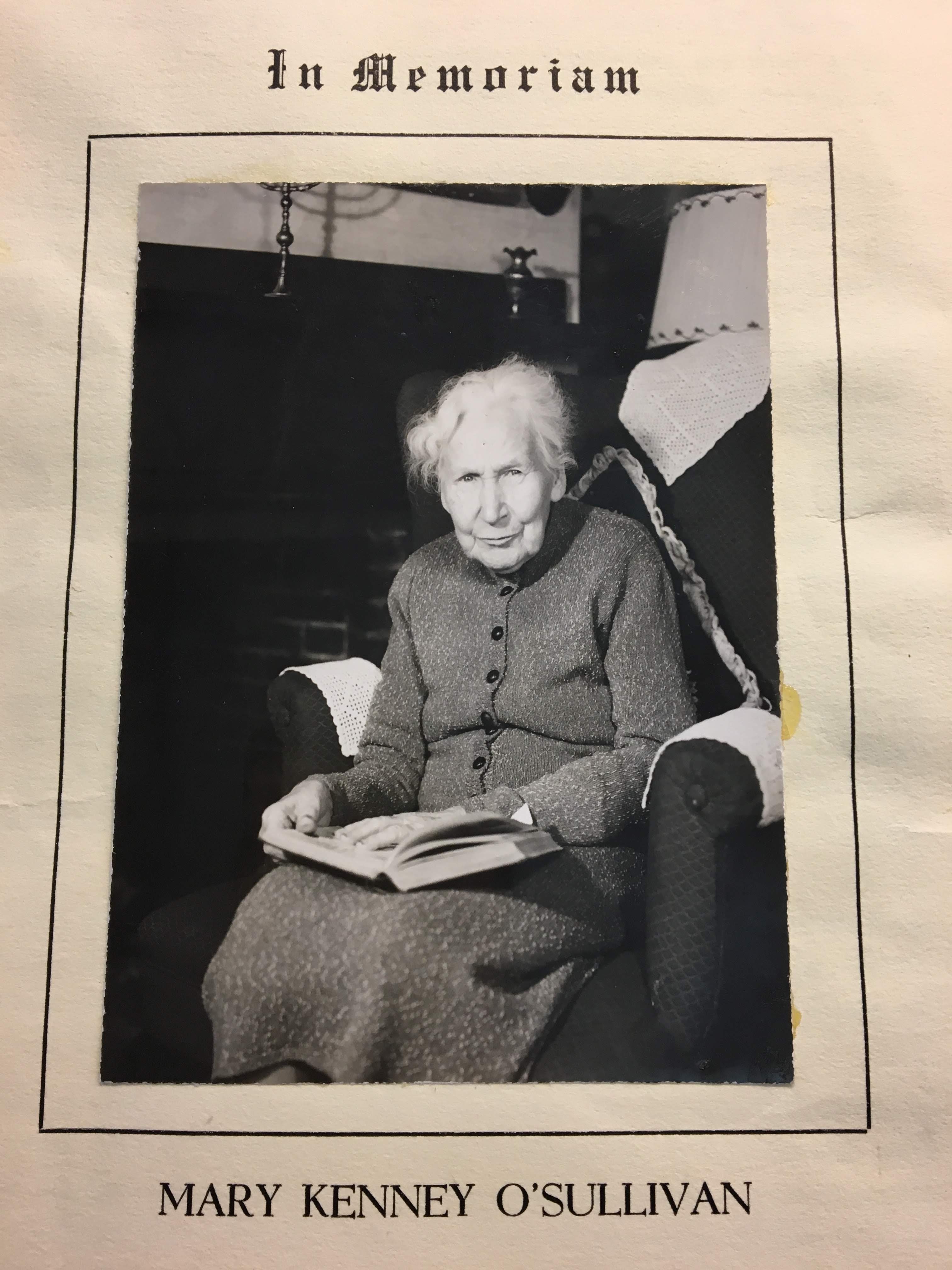
The most poignant item that I held in my hands for a long time was the program from her funeral; Mary passed away 10 days after her 79th birthday, on January 18, 1943. One of the most remarkable things about Mary, to me, was her enormous and diverse network of friends, allies, and colleagues. Her ability to build bridges with people so different from herself was likely the reason that, 80 years after her death, I could find her papers at an institute most would associate with well-educated, upper-class people.
Cover of the funeral program for Mary Kenney O’Sullivan, from the Papers of Mary Kenney O’Sullivan, 1892-1943 at the Schlesinger Library.
The eulogy is printed inside the program, and was written by Emily Greene Balch, a Wellesley professor and peace activist who went on to win the Nobel Peace Prize three years after Mary had passed on. Balch knew Mary from her youthful work at Hull House and their shared friendship with Jane Addams (1934 Nobel Peace Prize winner, oh by the way). She described Mary’s important work and some of the amazing men and women who were her allies and friends, including Supreme Court Justice Louis Brandeis. Her words at Mary’s death help bring her to life for me:
“She endeared herself to all who knew her by her rich nature, vigorous and outgoing, generous, humorous, tempestuous and loyal, by her capacity for never flagging devotion, spontaneous and without thought of credit or reward, her love of life and of people of every sort, rich and poor equally, and her deep-centered religiousness. She was a great comrade.”
Author’s photo of the bas relief bust of Mary Kenney O’Sullivan, part of the mixed media installation titled HEAR US: The Massachusetts Women’s Leadership Memorial in the Massachusetts State House, by Sheila DeBretteville, Susan Sellers, and Robert Shure, 1999.
I first learned about Mary Kenney O’Sullivan as part of a walking tour being developed in 2016. Now called Working Women: Boston Women Find Their Voice, the tour aims to tell the story of cross-class collaboration as women in Boston struggled to secure the vote for women. In 2016, I knew little about the suffrage movement and the actors in Boston, and absolutely nothing about the history of working women, labor unions, or settlement houses. Mrs. O’Sullivan quickly emerged as the heroine of this story. She was someone with a unique background and ability to bridge gaps between workers and employers, working and upper class people, women and men, and people of different faiths and ethnicities.
Learning to deliver a walking tour on topics one knows so little about is daunting. As I dove into the material, I felt the cold sweat of fear, and that I really needed to take a class to catch up on all the important social movements I never learned much about. Fortunately, it’s a truism for tour guides that most of what you share is new information to the people you are sharing it with. It’s great for a tour guide to have deep knowledge of the tour topics, but a walking tour is not a lecture series. Just knowing a little bit about, say, settlement houses, is a little bit more than most people, and the information I could share during the tour was enough to set the stage and get people interested in learning more on their own.
Once I grasped the basics of the broader topics, I felt calm enough to allow curiosity back into my learning process. The more I learned about Mary, the more I wanted to know — not only about the woman herself, but the people in her orbit, the ones she influenced and the ones who influenced her. A quick online search yields a number of basic outlines of her story, but what truly brought her to life for me in my early research were the excerpts of her own life story embedded in an academic work by Kathleen Banks Nutter. The Necessity of Organization: Mary Kenney O’Sullivan and Trade Unionism for Women, 1892-1912 was published in 2000 as part of a series in the history of American labor.
Dr. Nutter, affiliated with the Sophia Smith Collection at Smith College, used Mary’s own unpublished autobiography to bring her to life and emphasize her key role in the work to help women achieve fair treatment in the workplace through unions and legislation. This book was my first deep dive into Mary’s story, and it provided the best framework for developing the walking tour. I learned not only what Mary had to say about herself, but how others saw her, and how she occupied a unique space, particularly in Boston, in the struggle for women’s rights in the workplace and the public sphere.
I also learned that Dr. Nutter was one of the network of people who created and established HEAR US: The Massachusetts Women’s Leadership Memorial in the Massachusetts State House. The image on this post is my own photograph of part of this unusual memorial, which included five women in addition to Mary. An excellent bibliography of the women subjects who appear in art at the State House, as well as information on the women artists who created these and other works, is worth a look. The title HEAR US is so brilliantly appropriate to memorialize women who in their time were not expected to speak or write about issues of the day, whether it be the rights of the disabled, slavery, racism, access to education, the vote for women, or equal pay for equal work.
I’ll be writing more about my sources of learning about Mary. Just like in the walking tours I give, my aim in these posts is to help spark interest and curiosity and give some guidance on where to learn more. I’m grateful that there is some good information available online. I’m deeply grateful for Dr. Nutter’s work in telling Mary’s story through her book and the memorial. However, it’s not easy for most people – and it wasn’t so easy for me – to get hold of the book nor to visit the State House. After cashing in lot of credit card points, I now own the book. I took a day off of work to spend time in the State House, where the memorial is fairly hidden on a side hall. The building is not open on the weekends when a majority of the public – locals or tourists – would be more likely to visit. I’ll be sharing my view and the things I’ve been able to access for readers who may not be able to do so.
I became a walking tour guide in my early 40s. In the midst of a fulfilling and busy career in fire safety education and outreach, I was looking for something that would get me outside and challenge other parts of my brain. I found it when I stumbled across Boston By Foot, a nonprofit walking tour company that trains and organizes volunteers to talk about history and architecture. Since my “day job” involved commuting and travel around but not in Boston, I really missed being in the city on a daily basis. I was excited to share what I knew and was learning about the tourism stock in trade, events in the 1760s and 1770s leading to the American Revolution.
After all, growing up in Quincy, Massachusetts, in the 1970s, pretty much all I’d ever learned in public school history classes was about the riches surrounding us involving the birthplaces of Presidents John and John Quincy Adams, the USS Constitution, the Bunker Hill Monument, and Faneuil Hall. Boston By Foot helped me better appreciate the connection between individuals of that time, and how the colonial and early republic eras shaped Boston and America. It also taught me a lot that I just didn’t absorb in what I saw as boring, one-dimensional presentations in history class. As I gained confidence along with new knowledge, there were many more tours, developed by fellow volunteer guides, that I started to explore. Slowly, my knowledge expanded to include the stories of immigrant groups in Boston in the 1800s and early 20th century. So it wasn’t just white British Protestant fellows who shaped the city we live in now – hmmm!
And then in 2015, some fellow guides put together a tour dubbed Champions of Freedom that rocked my world. It focused on the unbelievably brave people – black and white, women and men – who risked their lives, livelihoods and reputations to end slavery, and at the same time, insisting on women’s rights on the long road to the women’s vote. A whole world of radicals, activists, resisters, and protestors came vividly to life. I was fascinated. And I was frustrated that, at my own mid-century mark, I had never heard a single thing about most of these people and the turbulent era of the Civil War and Reconstruction as it played out in Massachusetts. As I scrambled to catch up on all that I had missed learning throughout my life, I had my first epiphany. I was discovering the other side of the story – all the stories.
The women – half the population now, and then – began to wave hello to me from hidden corners of the tour manuals and history books. And not only the women behind the scenes, at home or on the farm making sure their men got fed and clothed. The women who spoke up, the women who spoke out, the women who started their own towns, their own religious denominations, their own schools, their own museums, their own movements. The women who saw problems and came up with solutions. The women who sued for their freedom, who fought to be heard, who changed not only their own lives but the course of history for everyone after them.
I had my second epiphany when my fellow guide Lucinda Gorry created a tour about women in the suffrage and labor movements, centered on a woman I’d never heard of named Mary Kenney O’Sullivan. In the process of learning so much new-to-me history — about settlement houses, labor unions and voting rights –- it dawned on me that Mrs. O’Sullivan was one of the most remarkable people I had ever encountered in my historical education. She was a bright, outspoken and passionate young woman as Mary Kenney in Missouri, who grew up working class but came to know the most powerful and well-educated upper-class women and men in the country. She struggled to be accepted as a respectable woman when society’s idea of one did not involve factory work and strikes. She built bridges between working people and the wealthy and well-educated power brokers of her time that helped to get labor laws on the books and women’s right to vote enshrined in a Constitutional amendment.
A newspaper clipping from The San Francisco Examiner documenting Mrs. O’Sullivan’s speech to strikers in Fall River, from the Papers of Mary Kenney O’Sullivan 1892-1943 at the Schlesinger Library, Harvard Radcliffe Institute, Cambridge, Mass.




 My heroines - amazing women in history