My first foray into non-electronic research about Mary Kenney O’Sullivan brought me to the Schlesinger Library, a unique resource for the history of women in the United States. It is at the Harvard Radcliffe Institute in Cambridge, Massachusetts. It’s a fairly young institute, born in 1999 but rooted in its own women’s history going back more than 100 years. Since Harvard University, founded in 1636, didn’t admit female students, Radcliffe College, founded in 1879, was the sister school. While women were enrolled in Harvard’s medical college and other graduate programs much earlier, Harvard did not become truly co-educational until 1974. I’d love to talk more about the women responsible for the very existence of Radcliffe (Elizabeth Cary Agassiz) and the Schlesinger Library (Maud Wood Park), but perhaps I’ll get to that in another post. What I want to share here is how I used this fantastic resource that is practically in my back yard to learn more about Mary Kenney O’Sullivan.
Even with Harvard right down the road, I felt a bit intimidated to pursue this next step in research, mainly because I have no idea what I’m doing, but also…Harvard…whew! The Schlesinger Library website is absolutely amazing, and during my Christmas break from work, I searched its site and others incessantly for more about my subject. I kept coming back to the information about how to visit and how to access materials, of course during a time the library was closed for the holiday break. By January 2020, I’d gotten organized enough and brave enough to make the visit.
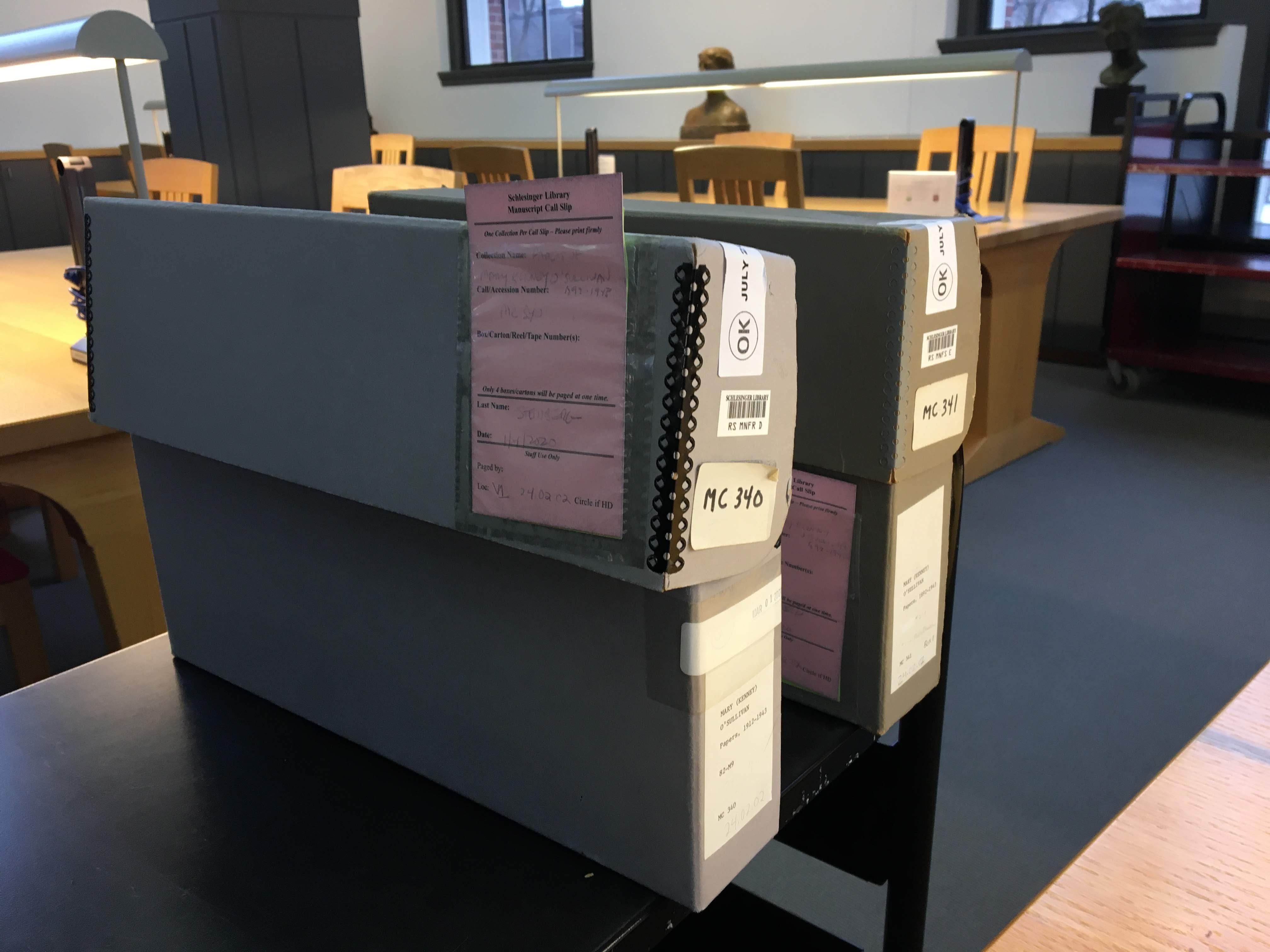
There was hardly anyone else visiting on a weekday before classes had started and the research librarians were helpful and efficient. First, they gave me access to download the scanned document that was Mary’s unpublished autobiography. Then they pulled the two file boxes containing the papers of Mary Kenney O’Sullivan, pointed out the rules for handling the items, and left me to go through them. I couldn’t believe I could “keep” Mary’s autobiography in digital form; and I was incredulous that I was about to handle her papers and effects.
So what was in those boxes? I was allowed to take photos of everything; I’m allowed to quote things; and I’m allowed to share images with proper attribution. Having read Kathleen Banks Nutter’s The Necessity of Organization, I knew a fair amount about Mary’s early life, her connection to Jane Addams and Hull House, her marriage to Jack O’Sullivan, and her work up until 1912 in organizing women in Boston and the surrounding area. Seeing and touching an envelope with Jane Addams’ scrawl addressed to Mary was surreal. Newspaper clippings were mostly in pretty bad shape, but provided an interesting backdrop to Mary’s life in trade unionism, suffrage, and the international peace movement. It was encouraging to know there was this much coverage that I will likely be able to find online. I found her train tickets, writer’s union card, a ragged ribbon on a pin with the suffrage colors, address books, and her official Massachusetts state government business card. I had to laugh at the last one as I was a state employee from 1987-1996 and apparently not even the font style had changed on those business cards in 60 years.

Yes, Mary was a state worker, an inspector with the Department of Labor and Industries in the Division of Industrial Safety. A tattered scrap of newsprint still held a story and photo of her retirement in 1934, days before her 70th birthday. It was the kind of job she might have had in her late 20s with the state of Illinois had she stayed in Chicago working with powerhouse activists like Jane Addams and Florence Kelley. Instead, it was her paid work in her energetic older years.
The most poignant item that I held in my hands for a long time was the program from her funeral; Mary passed away 10 days after her 79th birthday, on January 18, 1943. One of the most remarkable things about Mary, to me, was her enormous and diverse network of friends, allies, and colleagues. Her ability to build bridges with people so different from herself was likely the reason that, 80 years after her death, I could find her papers at an institute most would associate with well-educated, upper-class people.
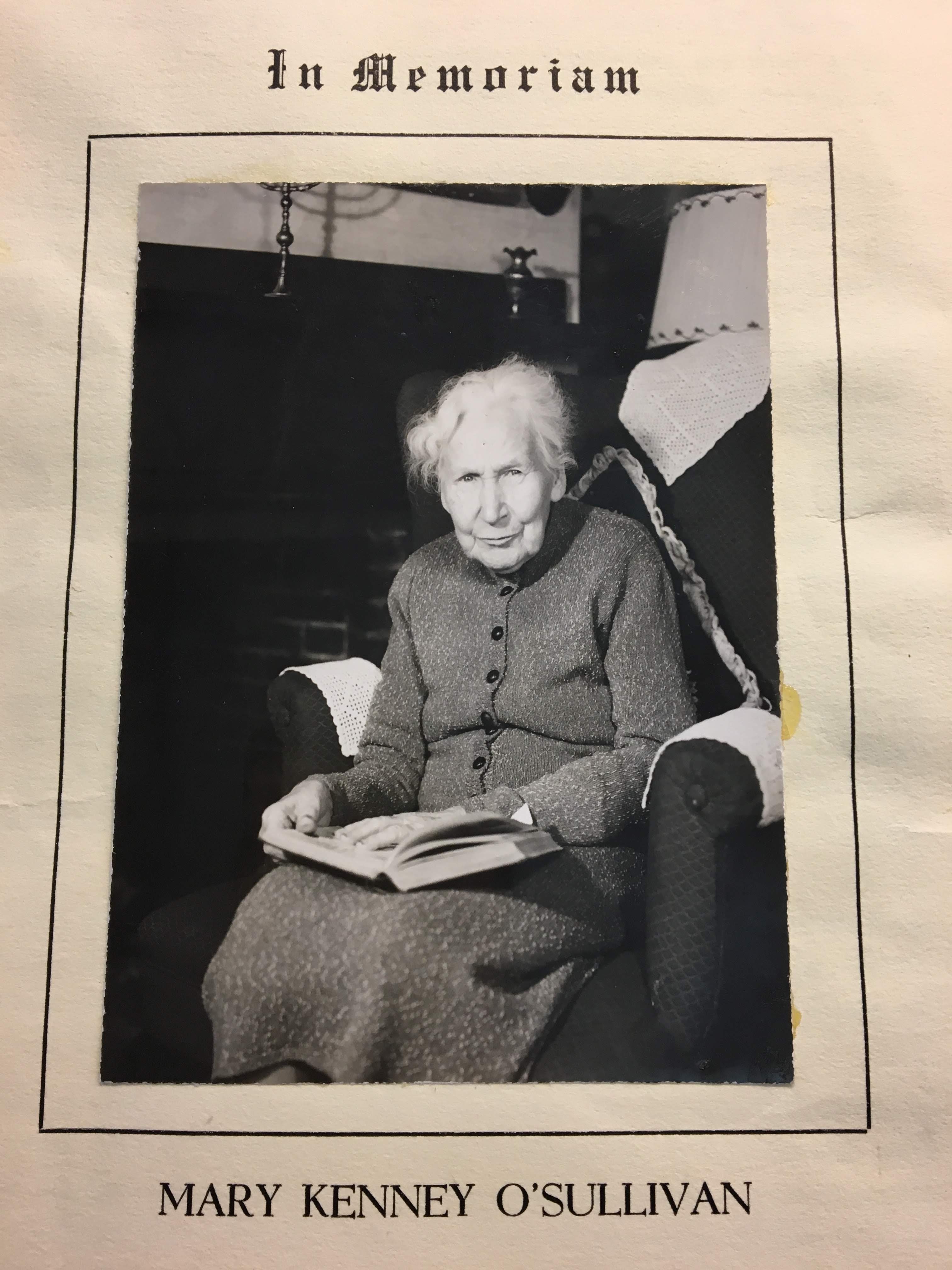
The eulogy is printed inside the program, and was written by Emily Greene Balch, a Wellesley professor and peace activist who went on to win the Nobel Peace Prize three years after Mary had passed on. Balch knew Mary from her youthful work at Hull House and their shared friendship with Jane Addams (1934 Nobel Peace Prize winner, oh by the way). She described Mary’s important work and some of the amazing men and women who were her allies and friends, including Supreme Court Justice Louis Brandeis. Her words at Mary’s death help bring her to life for me:
“She endeared herself to all who knew her by her rich nature, vigorous and outgoing, generous, humorous, tempestuous and loyal, by her capacity for never flagging devotion, spontaneous and without thought of credit or reward, her love of life and of people of every sort, rich and poor equally, and her deep-centered religiousness. She was a great comrade.”
 My heroines - amazing women in history