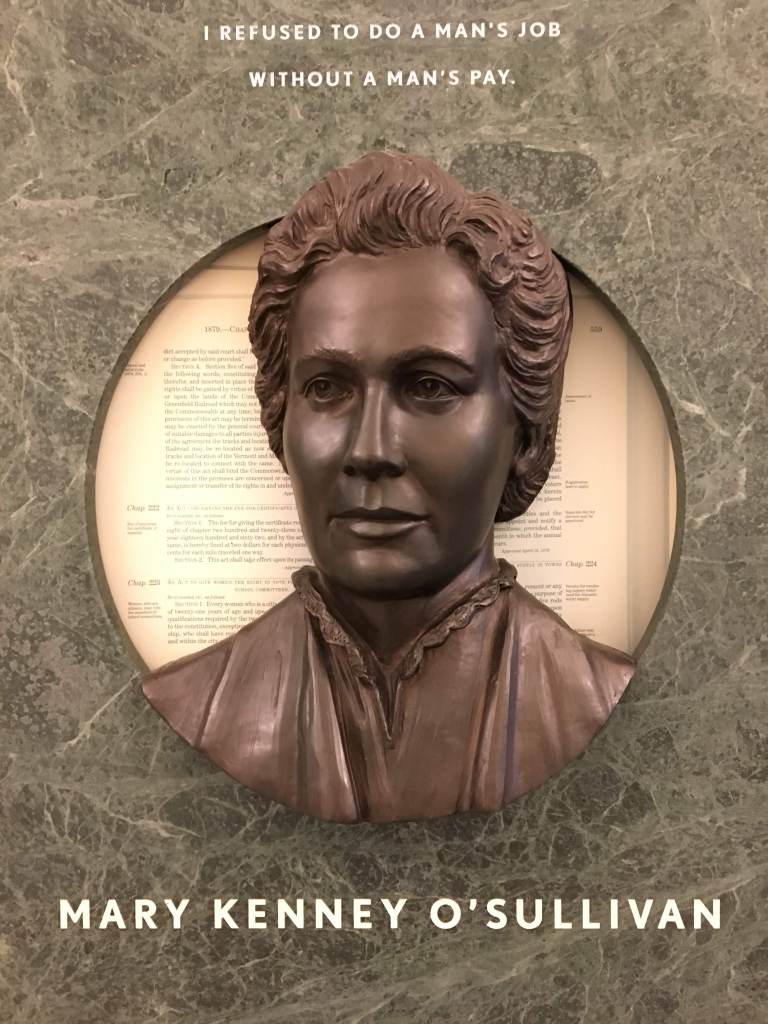
I first learned about Mary Kenney O’Sullivan as part of a walking tour being developed in 2016. Now called Working Women: Boston Women Find Their Voice, the tour aims to tell the story of cross-class collaboration as women in Boston struggled to secure the vote for women. In 2016, I knew little about the suffrage movement and the actors in Boston, and absolutely nothing about the history of working women, labor unions, or settlement houses. Mrs. O’Sullivan quickly emerged as the heroine of this story. She was someone with a unique background and ability to bridge gaps between workers and employers, working and upper class people, women and men, and people of different faiths and ethnicities.
Learning to deliver a walking tour on topics one knows so little about is daunting. As I dove into the material, I felt the cold sweat of fear, and that I really needed to take a class to catch up on all the important social movements I never learned much about. Fortunately, it’s a truism for tour guides that most of what you share is new information to the people you are sharing it with. It’s great for a tour guide to have deep knowledge of the tour topics, but a walking tour is not a lecture series. Just knowing a little bit about, say, settlement houses, is a little bit more than most people, and the information I could share during the tour was enough to set the stage and get people interested in learning more on their own.
Once I grasped the basics of the broader topics, I felt calm enough to allow curiosity back into my learning process. The more I learned about Mary, the more I wanted to know — not only about the woman herself, but the people in her orbit, the ones she influenced and the ones who influenced her. A quick online search yields a number of basic outlines of her story, but what truly brought her to life for me in my early research were the excerpts of her own life story embedded in an academic work by Kathleen Banks Nutter. The Necessity of Organization: Mary Kenney O’Sullivan and Trade Unionism for Women, 1892-1912 was published in 2000 as part of a series in the history of American labor.
Dr. Nutter, affiliated with the Sophia Smith Collection at Smith College, used Mary’s own unpublished autobiography to bring her to life and emphasize her key role in the work to help women achieve fair treatment in the workplace through unions and legislation. This book was my first deep dive into Mary’s story, and it provided the best framework for developing the walking tour. I learned not only what Mary had to say about herself, but how others saw her, and how she occupied a unique space, particularly in Boston, in the struggle for women’s rights in the workplace and the public sphere.
I also learned that Dr. Nutter was one of the network of people who created and established HEAR US: The Massachusetts Women’s Leadership Memorial in the Massachusetts State House. The image on this post is my own photograph of part of this unusual memorial, which included five women in addition to Mary. An excellent bibliography of the women subjects who appear in art at the State House, as well as information on the women artists who created these and other works, is worth a look. The title HEAR US is so brilliantly appropriate to memorialize women who in their time were not expected to speak or write about issues of the day, whether it be the rights of the disabled, slavery, racism, access to education, the vote for women, or equal pay for equal work.
I’ll be writing more about my sources of learning about Mary. Just like in the walking tours I give, my aim in these posts is to help spark interest and curiosity and give some guidance on where to learn more. I’m grateful that there is some good information available online. I’m deeply grateful for Dr. Nutter’s work in telling Mary’s story through her book and the memorial. However, it’s not easy for most people – and it wasn’t so easy for me – to get hold of the book nor to visit the State House. After cashing in lot of credit card points, I now own the book. I took a day off of work to spend time in the State House, where the memorial is fairly hidden on a side hall. The building is not open on the weekends when a majority of the public – locals or tourists – would be more likely to visit. I’ll be sharing my view and the things I’ve been able to access for readers who may not be able to do so.
 My heroines - amazing women in history
Mary sounds like quite a women. This was a very interesting read! Thank you for sharing her history. I gave your blog a follow and look forward to reading more!
LikeLike